

Breast Reconstruction Pathways
Latissimus Dorsi (LD) Flap Breast Reconstruction

A Latissimus Dorsi (LD) flap is a breast reconstruction procedure that uses skin, fat, and a portion of muscle from the upper back—sometimes combined with an implant—to rebuild the breast.
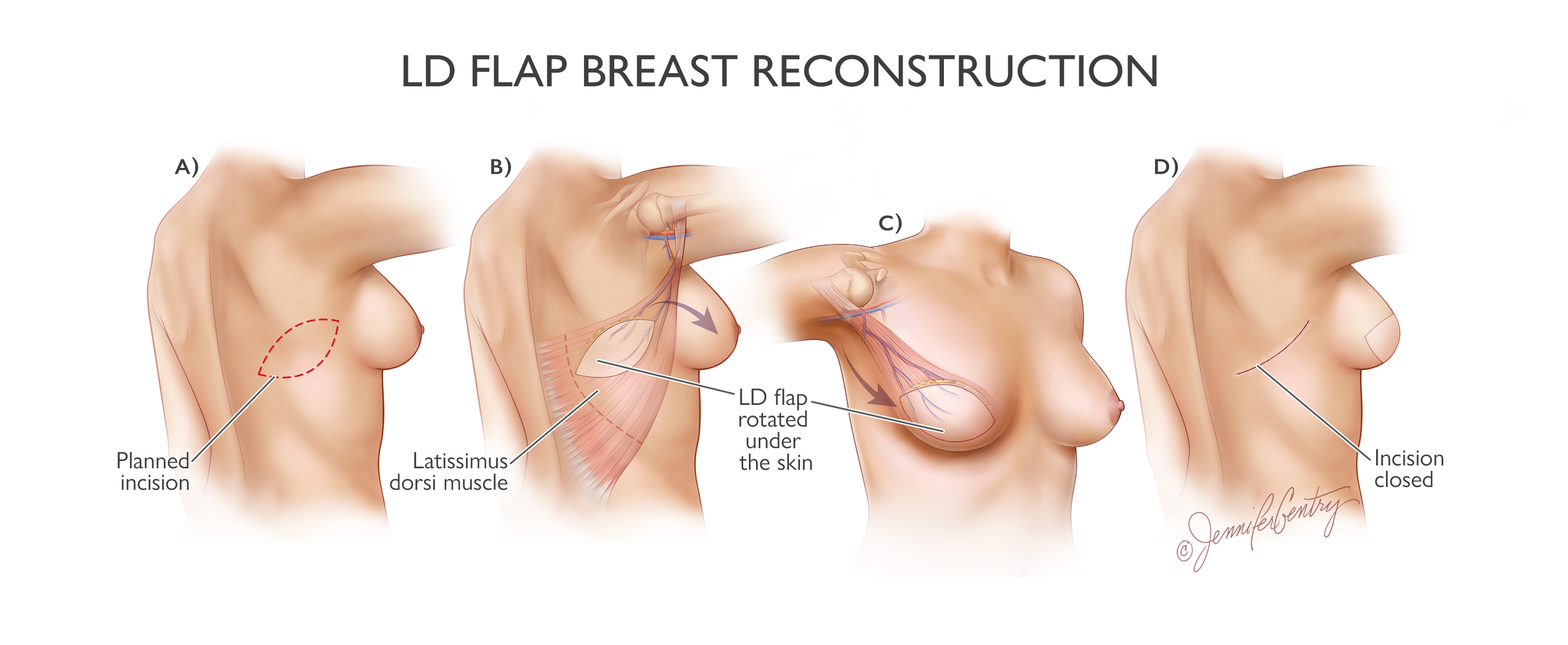
The Latissimus Dorsi flap, often called the LD flap, is a type of natural tissue breast reconstruction that uses skin, fat, and a small portion of muscle from your upper back to rebuild the breast.
This technique has been used safely for decades and is especially helpful for women who may not be candidates for abdominal flap procedures or who need extra tissue to support an implant.
How It Works
The latissimus dorsi muscle, along with a small amount of skin and fat, is taken from the upper back (just below the shoulder blade).
This flap of tissue is tunneled under the skin to the front of the chest.
The tissue is then shaped to create or improve a breast mound.
The blood supply remains attached (pedicled flap), so microsurgery is not required.
Sometimes the LD flap is combined with an implant to achieve the desired breast size and projection.
Who May Be a Candidate
The LD flap may be a good option if:
You are not a candidate for abdominal flaps (like DIEP or TRAM) due to anatomy, previous surgery, or lack of enough tissue.
You prefer a shorter, less complex surgery than free-flap procedures.
You’ve had radiation therapy and need healthy tissue to help cover and support an implant.
You want a reliable, time-tested reconstruction method.
Benefits of the LD Flap
Reliable option: The LD flap has a long track record of safety and success.
Shorter surgery: Usually less complex than free-flap microsurgery.
Can improve implant results: Provides healthy, well-vascularized tissue to cover an implant in women who have had radiation.
Flexible approach: Can be used alone (for smaller breasts) or combined with an implant (for larger size and shape).
Natural tissue: Adds softness and contour compared to implants alone.
Things to Keep in Mind
Muscle is used: Unlike DIEP or other flaps, the LD flap does remove some muscle, which can occasionally affect shoulder or back strength.
Scarring: Leaves a scar on the back, usually hidden under the bra line.
May need an implant: On its own, the LD flap often doesn’t provide enough volume for larger breasts.
Recovery: Typically 4–6 weeks, with some soreness in both the back and chest.
Not always permanent fix: Implants (if used) may need revision or replacement in the future.
Emotional Considerations
Some women appreciate the reliability of the LD flap and the fact that it avoids abdominal surgery. Others may worry about muscle loss or the idea of taking tissue from their back. Both responses are normal. Talking with your surgeon about lifestyle, activity level, and body goals can help determine if this is the right fit.
A Personal Choice
The Latissimus Dorsi flap uses your own back tissue—sometimes paired with an implant—to rebuild the breast, blending reliability with natural softness. It may not be as commonly used as abdominal flaps today, but for many women, it remains an excellent choice.
At Coastal Hope for Healing, we believe that every woman’s reconstruction journey is unique. Whether you choose an LD flap, another flap, implants, or flat closure, you deserve clear information and compassionate support every step of the way.