

Breast Reconstruction Pathways
Superficial Inferior Epigastric Artery (SIEA) or Perforator (SIEP) Flap Breast Reconstruction

A Superficial Inferior Epigastric Artery (SIEA) or Perforator (SIEP) flap is a breast reconstruction procedure that uses skin, fat, and superficial blood vessels from the lower abdomen—without cutting through or removing muscle—to create a natural breast, when suitable vessels are present.
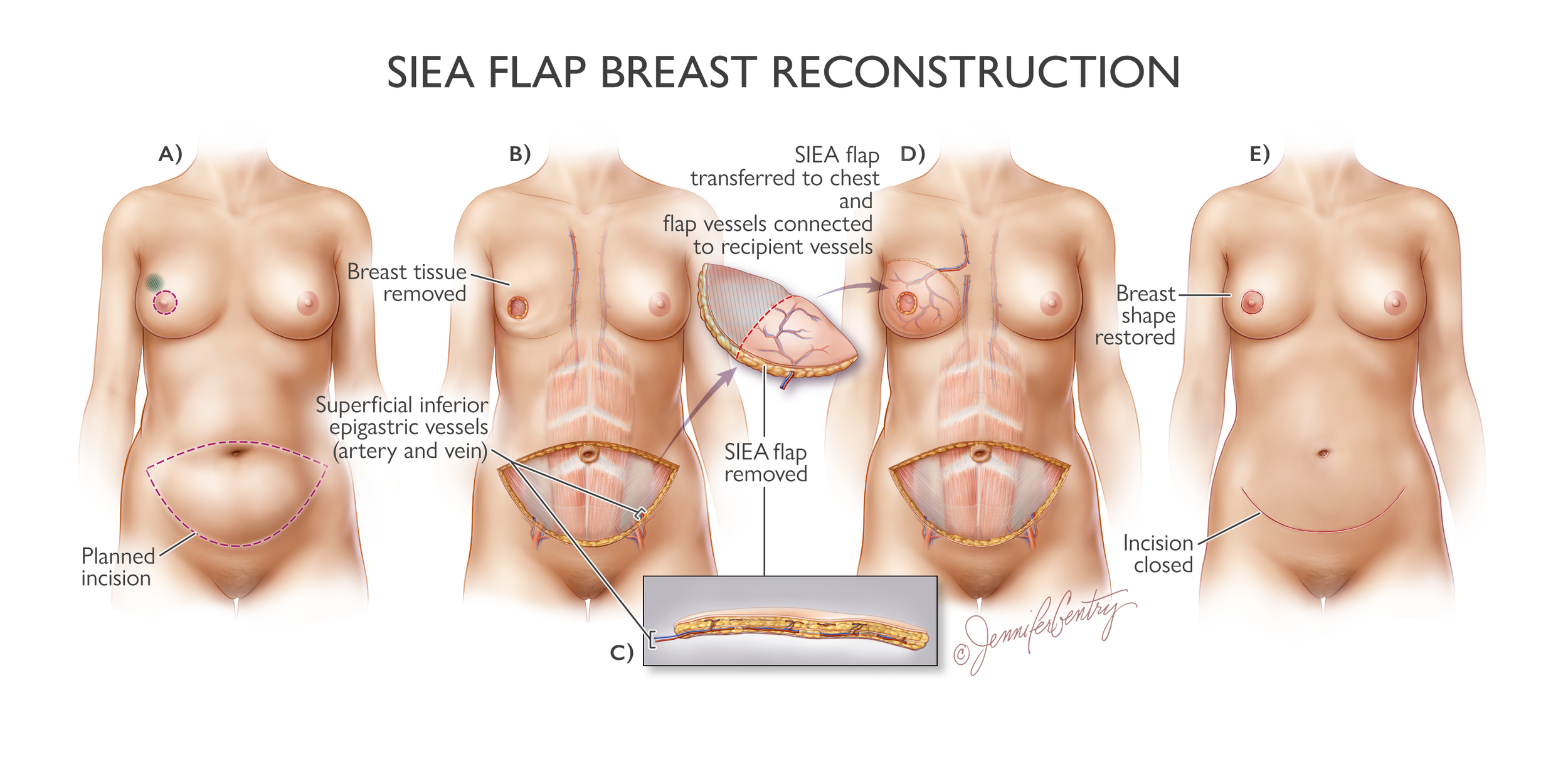
The SIEA flap (sometimes called the SIEP flap, short for Superficial Inferior Epigastric Artery/Perforator flap) is a type of natural tissue breast reconstruction. Like the DIEP flap, it uses skin and fat from the lower abdomen—giving results that look and feel natural, with the added benefit of a “tummy tuck” effect.
What makes the SIEA flap different is that it does not use muscle or even cut through the abdominal muscles. Instead, it relies on superficial blood vessels near the skin’s surface to keep the flap alive. This makes it one of the most muscle-sparing options available—but it’s only possible if those blood vessels are strong and well developed.
How It Works
The surgeon takes skin, fat, and superficial blood vessels from the lower abdomen.
The deeper abdominal muscles and blood vessels (used in a DIEP or TRAM flap) are left completely untouched.
Using microsurgery, the superficial blood vessels from the flap are reconnected to vessels in the chest.
The tissue is then shaped to form a new breast mound.
Who May Be a Candidate
SIEA flap reconstruction is not an option for everyone, because not all women have strong enough superficial blood vessels in the abdomen. It may be considered if:
You want a breast that looks and feels natural using your own tissue.
You have enough lower abdominal tissue to donate.
You want to avoid using or cutting through abdominal muscles.
Imaging (such as CT angiography) shows you have good superficial blood vessels to support the flap.
If those vessels aren’t suitable, your surgeon may recommend a DIEP flap instead.
Benefits of the SIEA Flap
No muscle involvement: Completely spares the abdominal muscles, lowering the risk of weakness, hernia, or bulging.
Natural look and feel: Uses your own skin and fat, which feels more like natural breast tissue.
“Tummy tuck” effect: Leaves the abdomen flatter and tighter after removing lower belly tissue.
Durability: Unlike implants, flap tissue typically lasts for life without the need for replacement.
Things to Keep in Mind
Rare option: Only about 10–20% of women have suitable vessels for this procedure, so it is less commonly performed.
Complex surgery: Requires advanced microsurgical skill and longer surgery time.
Longer recovery: Expect several weeks of healing, with activity restrictions during early recovery.
Abdominal scar: Leaves a horizontal scar across the lower abdomen, similar to a C-section or tummy tuck.
Not for everyone: Very thin women, smokers, or those with certain medical conditions may not be candidates.
Emotional Considerations
Women who are able to have an SIEA flap often feel comforted knowing their reconstruction used only fat and skin—not muscle. Many appreciate the natural look and feel, as well as the body-contouring effect on the abdomen. At the same time, it can feel disappointing if imaging shows the superficial vessels aren’t suitable. That’s why surgeons often prepare patients for the possibility of switching to a DIEP flap during surgery if needed.
A Personal Choice
The SIEA flap rebuilds the breast with your own tissue while leaving your abdominal muscles completely untouched—offering natural results with maximum muscle preservation. It is one of the most muscle-sparing reconstruction options available, but it isn’t possible for everyone. If it’s an option for you, it may provide natural, long-lasting results without sacrificing abdominal muscle strength.
At Coastal Hope for Healing, we want you to feel informed and supported, no matter which reconstruction path you choose. Whether it’s SIEA, DIEP, another flap, implants, or flat closure, your journey is valid—and we’re here to walk beside you.